What is MOTS-c?
MOTS-c (Mitochondrial Open Reading Frame of the 12S rRNA-c) is a 16-amino-acid peptide encoded within the 12S ribosomal RNA gene of mitochondrial DNA. Unlike most peptides, which are written in the DNA of the cell nucleus, MOTS-c comes from the mitochondria — the parts of the cell that produce energy.
Researchers study MOTS-c as a regulator of metabolic homeostasis: how the cell senses energy, handles glucose, and responds to exercise. Everything on this page is drawn from peer-reviewed literature and is presented for research reference only.

The sequence is the molecule
MOTS-c has no published 3D structure to render, so the verified sequence itself is the visual. Sixteen amino acids, numbered, color-coded by residue class:
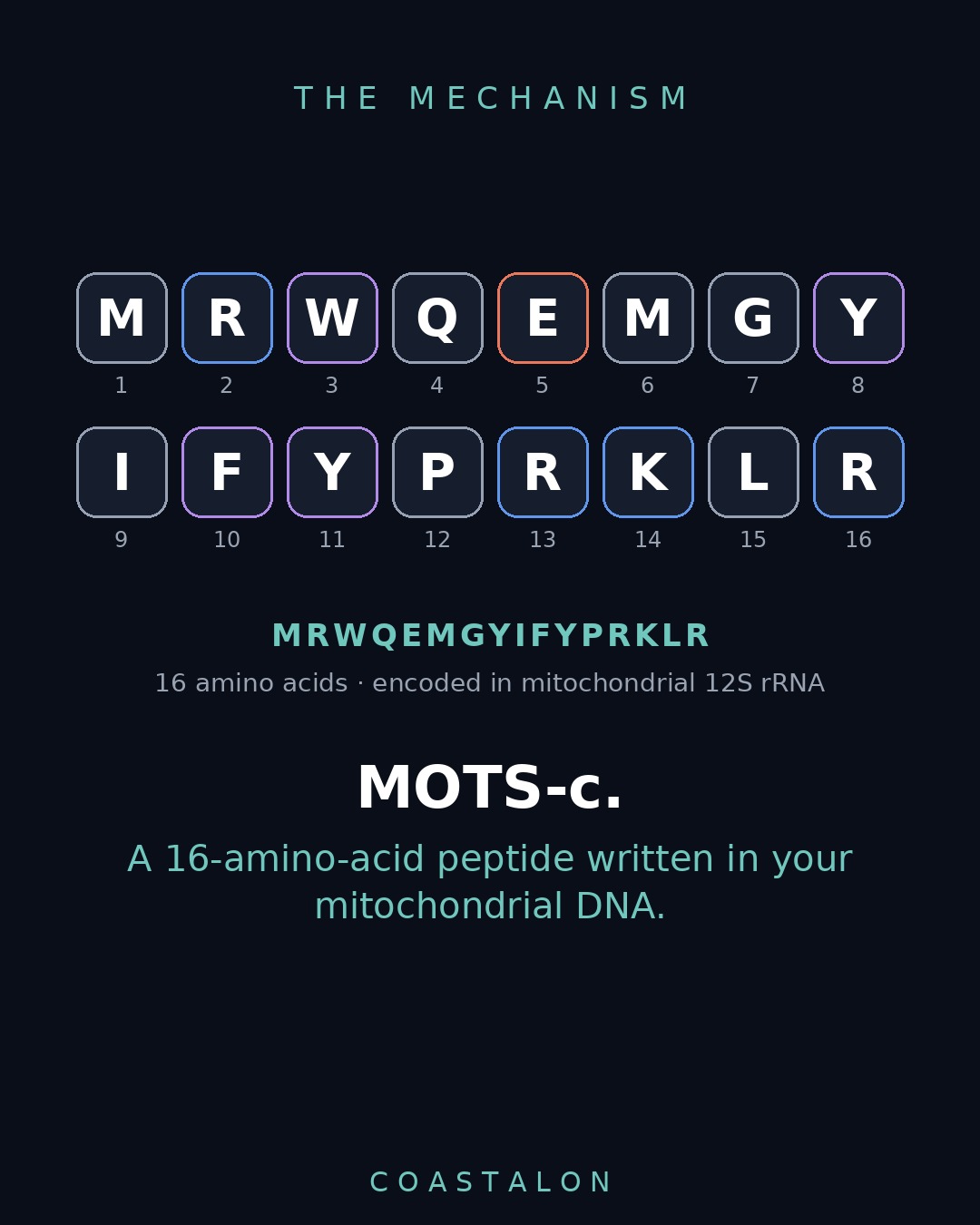
MRWQEMGYIFYPRKLR
That string is the whole peptide: methionine, arginine, tryptophan, glutamine, glutamate, methionine, glycine, tyrosine, isoleucine, phenylalanine, tyrosine, proline, arginine, lysine, leucine, arginine. It is encoded in the mitochondrial MT-RNR1 gene (12S rRNA).
The mechanism, in plain language
MOTS-c works like a message from the mitochondria to the rest of the cell. In three steps:
-
1
It nudges the folate cycle
MOTS-c interferes with the folate cycle — the pathway cells use to build purines, the raw material of DNA and energy molecules.
-
2
AICAR builds up
Disrupting the folate cycle causes AICAR, a naturally occurring metabolite, to accumulate inside the cell.
-
3
AMPK wakes up
AICAR switches on AMPK, the cell’s energy sensor. AMPK then shifts the cell toward burning fat, taking up glucose, and making more mitochondria.
Under metabolic stress, MOTS-c can also move from the mitochondria into the nucleus, where it interacts with gene promoters involved in the stress response.
What the research shows
The landmark study is Lee et al., published in Cell Metabolism in 2015. In mice, MOTS-c treatment prevented diet-induced obesity and age-dependent insulin resistance. The same study showed the effect runs through the folate cycle and AMPK activation described above, with skeletal muscle as the primary target organ.
Later work found MOTS-c is induced by exercise: Reynolds et al. (2021) showed it acts as an exercise-induced regulator of age-dependent physical decline and muscle homeostasis.
Scope matters here: these findings come from mouse studies and cell models. They describe what researchers observed in the lab — not effects in humans.
Molecular specifications
| Amino Acid Sequence | MRWQEMGYIFYPRKLR |
|---|---|
| Residues | 16 amino acids |
| Molecular Weight | 2,174.6 g/mol |
| Molecular Formula | C101H152N28O22S2 |
| CAS Number | 1627580-64-6 |
| Encoded In | Mitochondrial 12S rRNA (MT-RNR1) |
Selected literature
The following peer-reviewed references informed this page. Citations are provided for scientific context only.
- Lee C, Zeng J, Drew BG, Sallam T, Martin-Montalvo A, Wan J, Kim S-J, Mehta H, Hevener AL, de Cabo R, Cohen P. The mitochondrial-derived peptide MOTS-c promotes metabolic homeostasis and reduces obesity and insulin resistance. Cell Metabolism, 2015; 21(3): 443–454. doi:10.1016/j.cmet.2015.02.009. PMID 25738459.
- Kim SJ, et al. MOTS-c: a mitochondrial encoded regulator of the nucleus. Biogerontology, 2018; 19(6): 547–555.
- Reynolds JC, et al. MOTS-c is an exercise-induced mitochondrial-encoded regulator of age-dependent physical decline and muscle homeostasis. Nature Communications, 2021; 12(1): 470.
Research Disclaimer
This product is intended strictly for laboratory research purposes only. It is not a drug, food, cosmetic, or dietary supplement and is not intended to diagnose, treat, cure, or prevent any disease. It is not for human or animal consumption. All information presented is derived from published scientific literature and is provided for educational reference only. By purchasing, the buyer affirms they are a qualified researcher or institution and assume full responsibility for the safe and lawful handling of this material.