All 44 residues — plus one cap
Tesamorelin is [hexenoyl-trans-3-Tyr1]hGRF(1-44)NH2 — the full 44-residue human GHRH sequence, with a trans-3-hexenoyl cap attached to the first tyrosine. It was developed as TH9507 by Theratechnologies.
Native GHRH clears in minutes because DPP-4 clips it right at the front, between Tyr1 and Ala2. The cap on Tyr1 blocks the enzyme’s access — so the full-length signal survives long enough to reach the pituitary.
The full 44-residue strip
The 44-residue strip below is the molecule visual — the verified sequence, with the cap flagged on the first tyrosine:
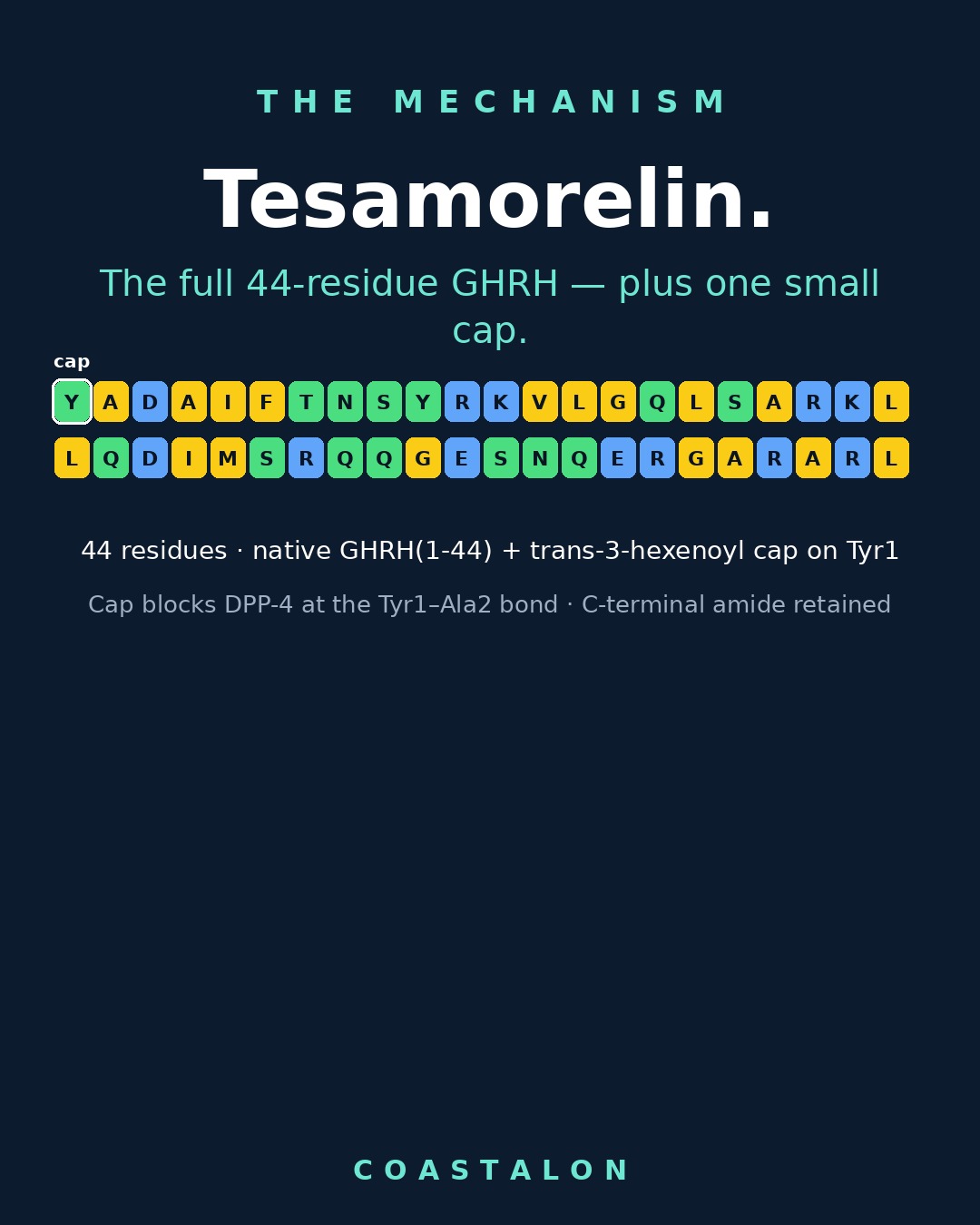
Full sequence: hexenoyl-Tyr-Ala-Asp-Ala-Ile-Phe-Thr-Asn-Ser-Tyr-Arg-Lys-Val-Leu-Gly-Gln-Leu-Ser-Ala-Arg-Lys-Leu-Leu-Gln-Asp-Ile-Met-Ser-Arg-Gln-Gln-Gly-Glu-Ser-Asn-Gln-Glu-Arg-Gly-Ala-Arg-Ala-Arg-Leu-NH2.
Same receptor, complete signal
- The cap blocks DPP-4. The trans-3-hexenoyl group on Tyr1 sterically blocks the enzyme from cutting the Tyr1–Ala2 bond.
- The full signal survives. Instead of clearing in minutes, the intact 44-residue signal reaches the pituitary.
- It binds the GHRH receptor. Same receptor as CJC-1295 — and the pituitary answers with a pulse of GH. The difference is the signal itself: complete, not truncated.
Design first, non-clinical evidence
No half-life number appears here on purpose: reported tesamorelin half-life figures vary by source (roughly 26–38 minutes), so the honest claim is only that the cap lets the signal survive long enough to reach the pituitary.
The non-clinical pharmacology comes from Ferdinandi et al. (Basic and Clinical Pharmacology and Toxicology, 2007), evaluating TH9507: the study reported DPP-IV resistance and enhanced potency and duration of action versus unmodified hGRF(1-44)NH2. No human efficacy claim is made here.
Molecular specifications
| Amino Acid Sequence | Trans-3-hexenoic acid-Tyr-Ala-Asp-Ala-Ile-Phe-Thr-Asn-Ser-Tyr-Arg-Lys-Val-Leu-Gly-Gln-Leu-Ser-Ala-Arg-Lys-Leu-Leu-Gln-Asp-Ile-Met-Ser-Arg-Gln-Gln-Gly-Glu-Ser-Asn-Gln-Glu-Arg-Gly-Ala-Arg-Ala-Arg-Leu-NH₂ |
|---|---|
| Molecular Weight | ~5,136 g/mol |
| Molecular Formula | C₂₂₁H₃₆₆N₇₂O₆₇S |
| CAS Number | 218949-48-5 |
| Storage | −20°C long-term, 4°C short-term up to 4 weeks |
Selected literature
The following peer-reviewed references informed this page. Citations are provided for scientific context only.
- Ferdinandi ES, et al. “Non-clinical pharmacology of TH9507 (tesamorelin).” Basic Clin Pharmacol Toxicol. 2007. (TH9507 evaluation: DPP-IV resistance and enhanced potency/duration of action vs unmodified hGRF(1-44)NH2.)
- Composition: tesamorelin = [hexenoyl-trans-3-Tyr1]hGRF(1-44)NH2, formula C221H366N72O67S, MW ~5,136 Da, CAS 218949-48-5 (free base).
Research Disclaimer
This product is intended strictly for laboratory research purposes only. It is not a drug, food, cosmetic, or dietary supplement and is not intended to diagnose, treat, cure, or prevent any disease. It is not for human or animal consumption. All information presented is derived from published scientific literature and is provided for educational reference only. By purchasing, the buyer affirms they are a qualified researcher or institution and assume full responsibility for the safe and lawful handling of this material.