One target: NNMT
5-Amino-1MQ is a small molecule with one target: NNMT (nicotinamide N-methyltransferase), the enzyme that methylates nicotinamide and diverts it away from the NAD+ salvage pathway.
Think of the salvage pathway as a recycling loop: the cell rebuilds NAD+ from its precursors. NNMT is a drain on that loop — it takes nicotinamide (NAM) and turns it into 1-methylnicotinamide, which cannot be recycled into NAD+. 5-Amino-1MQ plugs the drain, so the salvage pathway keeps flowing.
The real structure
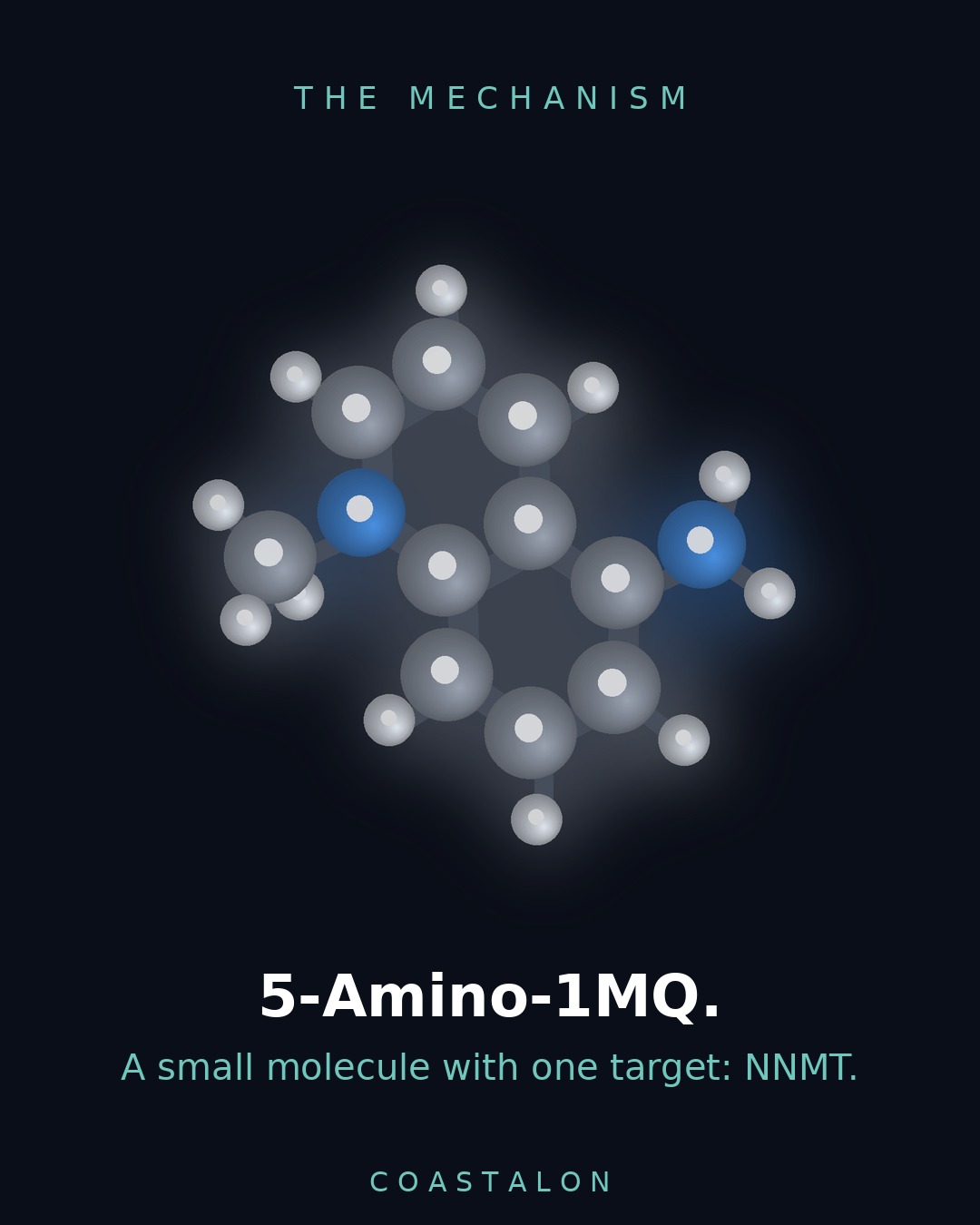
5-Amino-1MQ is a small molecule, not a peptide. Its structure is shown below — built from the actual atomic coordinates, not a stylized drawing.
In structure–activity work, 5-amino-1MQ showed an IC50 of 1.2 µM against NNMT and was selective for that enzyme (Neelakantan et al., 2017).
Plug the drain, keep the salvage flowing
- NNMT drains NAD+ precursors. The enzyme methylates nicotinamide (NAM) using SAM, producing 1-methylnicotinamide — a dead end for NAD+ recycling.
- 5-Amino-1MQ inhibits NNMT. By blocking the enzyme, it keeps NAM available for the salvage pathway.
- The salvage pathway keeps flowing. With NAM no longer diverted, the cell can keep rebuilding NAD+ through NAMPT.
What mouse studies found
In mouse studies, NNMT inhibition with 5-amino-1MQ was linked to lower fat mass and higher energy expenditure (Neelakantan et al., Biochemical Pharmacology, 2018). In diet-induced obese mice, treatment reduced body weight, white adipose mass, and adipocyte size — with no effect on food intake. In cells, it reduced intracellular 1-methylnicotinamide, raised intracellular NAD+, and suppressed lipogenesis.
These are mouse-study findings, reported here as research — not human efficacy claims.
Molecular specifications
| Amino Acid Sequence | N/A — 5-Amino-1MQ is a small molecule, not a peptide |
|---|---|
| Molecular Weight | 174.2 g/mol |
| Molecular Formula | C₁₀H₁₀N₂ |
| CAS Number | 1380437-86-4 |
| Storage | −20°C long-term, 4°C short-term up to 4 weeks |
Selected literature
The following peer-reviewed references informed this page. Citations are provided for scientific context only.
- Neelakantan H, et al. “Selective and membrane-permeable small molecule inhibitors of nicotinamide N-methyltransferase reverse high fat diet-induced obesity in mice.” Biochem. Pharmacol. 2018; 147: 141–52.
- Neelakantan H, et al. “Structure-activity relationship for small molecule inhibitors of nicotinamide N-methyltransferase.” J. Med. Chem. 2017; 60: 5015–28.
- Kraus D, et al. “Nicotinamide N-methyltransferase knockdown protects against diet-induced obesity.” Nature 2014; 508: 258–62.
Research Disclaimer
This product is intended strictly for laboratory research purposes only. It is not a drug, food, cosmetic, or dietary supplement and is not intended to diagnose, treat, cure, or prevent any disease. It is not for human or animal consumption. All information presented is derived from published scientific literature and is provided for educational reference only. By purchasing, the buyer affirms they are a qualified researcher or institution and assume full responsibility for the safe and lawful handling of this material.