The recovery peptide everyone asks about
BPC-157 is the 15-amino-acid peptide researchers study for how the body rebuilds tissue. Tendons and ligaments heal slowly — barely any blood gets there — and in animal studies, BPC-157 is studied for how it helps the body grow new blood vessels and wake up the repair cells in those tissues.
It was first found in stomach acid — a fragment of a protein from human gastric juice — which is why it survives where most peptides fall apart. That stability is the reason researchers keep coming back to it.
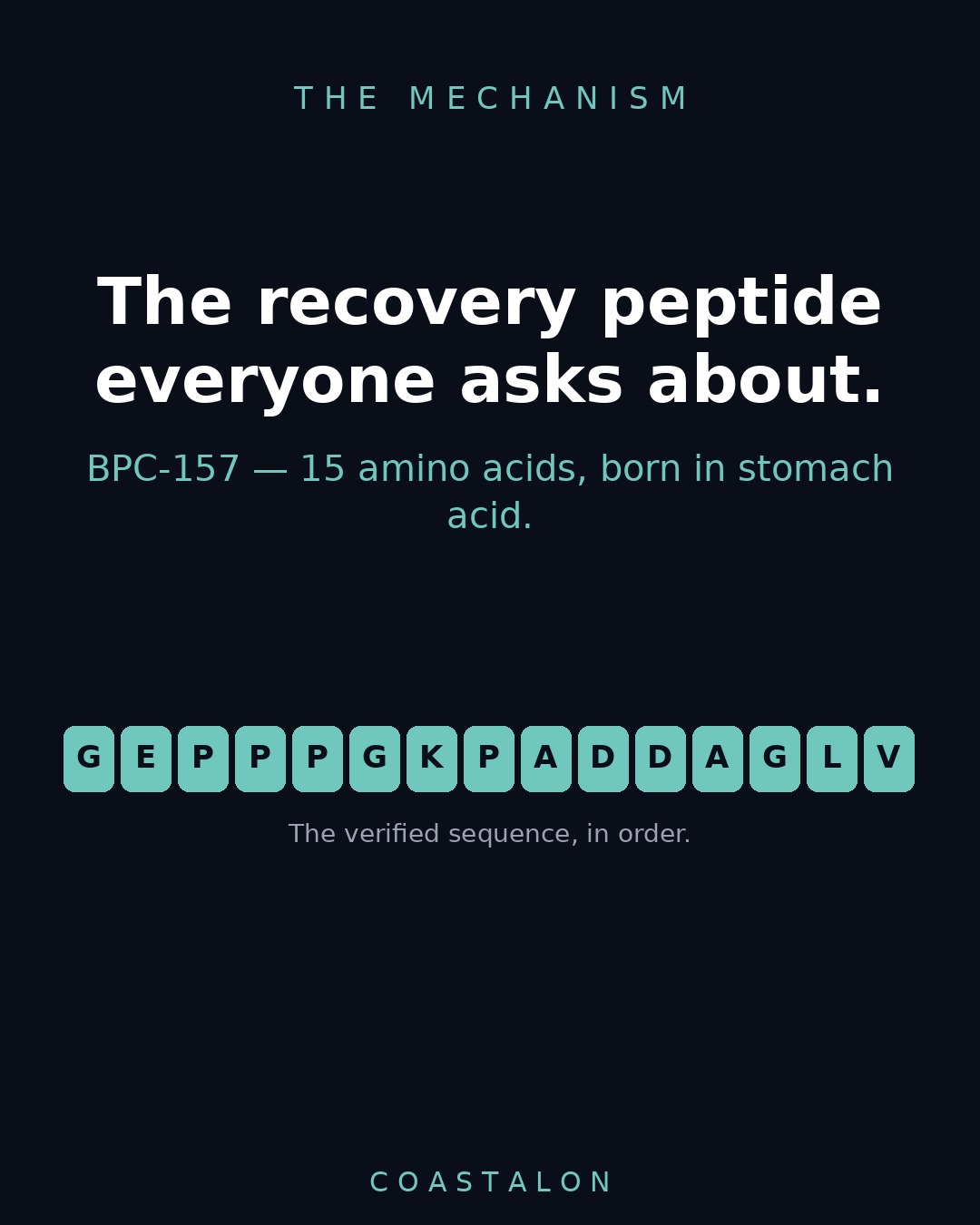
Fifteen amino acids, born in stomach acid
BPC-157 (Body Protection Compound-157) is a synthetic linear pentadecapeptide — fifteen amino acids, with free N- and C-termini. Its discoverers described it as a partial sequence of a protein (BPC) from human gastric juice, and called it a “stable gastric pentadecapeptide” because it survives in gastric juice.
Gly-Glu-Pro-Pro-Pro-Gly-Lys-Pro-Ala-Asp-Asp-Ala-Gly-Leu-Val
The sequence above is the molecule visual — the verified sequence from PubChem CID 9941957, in order: GEPPPGKPADDAGLV. It is also known as PL-14736 / PLD-116.
How it works, in plain words
- New blood vessels. In preclinical research, BPC-157 is studied for how it helps the body grow vessels into tissue that barely gets blood. The reported signaling runs through VEGFR2 — the VEGFR2–Akt–eNOS pathway (Hsieh et al., 2017).
- Repair cells, moving. It is studied for how it wakes tendon cells up and sends them to the damage — tendon fibroblast outgrowth, survival under oxidative stress, and migration via the FAK–paxillin pathway (Chang et al., 2011).
- Growth signals, louder. It is studied for how it turns up the receptors that hear the body’s own repair calls — growth-hormone-receptor upregulation in tendon fibroblasts (Chang et al., 2014).
That is the recovery peptide, in one sentence: new vessels, moving repair cells, louder growth signals — in research, not in people.

Over 100 animal studies. Almost no human data.
The honest part of this episode is the evidence gap, and this page states it plainly rather than burying it. A 2025 systematic review of 36 studies (1993–2024) found 35 preclinical studies and 1 clinical study; no completed human randomized trial for tendon injury exists.
Only three small human studies have been reported: a knee-pain study (n=12), an interstitial cystitis study, and an intravenous safety pilot (n=2). A Phase 2 ulcerative-colitis trial of rectal PL-14736 was completed, but its results were never released. Most of the literature comes from one group (Sikiric, University of Zagreb); independent replication is limited.
The animal case is strong; the human case is barely started. That is the honest verdict — research literature only, not a human outcome claim for this product.
Molecular specifications
| Amino Acid Sequence | Gly-Glu-Pro-Pro-Pro-Gly-Lys-Pro-Ala-Asp-Asp-Ala-Gly-Leu-Val |
|---|---|
| Molecular Weight | ~1,419.5 g/mol |
| Molecular Formula | C₆₂H₉₈N₁₆O₂₂ |
| CAS Number | 137525-51-0 |
| Also Known As | PL-14736 / PLD-116 |
| Status | Not FDA-approved — research use only |
| Storage | −20°C long-term, 4°C short-term up to 4 weeks |
Selected literature
The following peer-reviewed references informed this page. Citations are provided for scientific context only.
- Sikiric P, et al. “The beneficial effect of BPC 157, a 15 amino acid peptide BPC fragment, on gastric and duodenal lesions induced by restraint stress, cysteamine and 96% ethanol in rats.” Life Sciences. 1994. (PMID 7904712) — BPC-157 described as a partial sequence of a protein from human gastric juice.
- Hsieh MJ, et al. “Therapeutic potential of pro-angiogenic BPC157 and inhibitive of the VEGFR2-Akt-eNOS signaling pathway.” J Mol Med. 2017; 95(3): 323–333. (PMID 27847966) — angiogenesis via VEGFR2 upregulation and activation.
- Chang CH, et al. “The promoting effect of pentadecapeptide BPC 157 on tendon healing involves tendon outgrowth, cell survival, and cell migration.” J Appl Physiol. 2011; 110: 774–780. (PMID 21030672) — tendon fibroblast outgrowth and migration via the FAK–paxillin pathway.
- Chang CH, et al. “Pentadecapeptide BPC 157 enhances the growth hormone receptor expression in tendon fibroblasts.” Molecules. 2014; 19: 19066–19077. (PMID 25415472) — growth-hormone-receptor upregulation in tendon fibroblasts.
- Staresinic M, et al. “The effect of pentadecapeptide BPC 157 on healing of transected Achilles tendon in rat.” J Orthop Res. 2003. (PMID 14554208) — rat Achilles-tendon transection healing.
- Identity: BPC-157, synthetic linear pentadecapeptide, sequence GEPPPGKPADDAGLV, formula C62H98N16O22, MW ~1419.5 Da, CAS 137525-51-0, PubChem CID 9941957. Also known as PL-14736 / PLD-116.
- Evidence note: 2025 systematic review of 36 studies (1993–2024) found 35 preclinical and 1 clinical; no completed human randomized trial for tendon injury. Only three small human studies reported (knee pain n=12, interstitial cystitis, IV safety pilot n=2). Most of the literature comes from one group (Sikiric, University of Zagreb); independent replication is limited.
Research Disclaimer
This product is intended strictly for laboratory research purposes only. It is not a drug, food, cosmetic, or dietary supplement and is not intended to diagnose, treat, cure, or prevent any disease. It is not for human or animal consumption. All information presented is derived from published scientific literature and is provided for educational reference only. By purchasing, the buyer affirms they are a qualified researcher or institution and assume full responsibility for the safe and lawful handling of this material.