The repair crew
Cerebrolysin is studied for how its peptides mimic the brain’s own growth factors. Your brain repairs itself with signals like BDNF and NGF — the factors that keep neurons alive and growing — and Cerebrolysin is a mixture of 100+ small peptides studied for how they mimic those same signals, in research, not in people.
That last part is the point of the episode: Cerebrolysin is not one peptide. It is a whole crew — a standardized preparation of low-molecular-weight peptides and free amino acids, and one of the most studied compounds in the research literature.
A crew, not a solo act
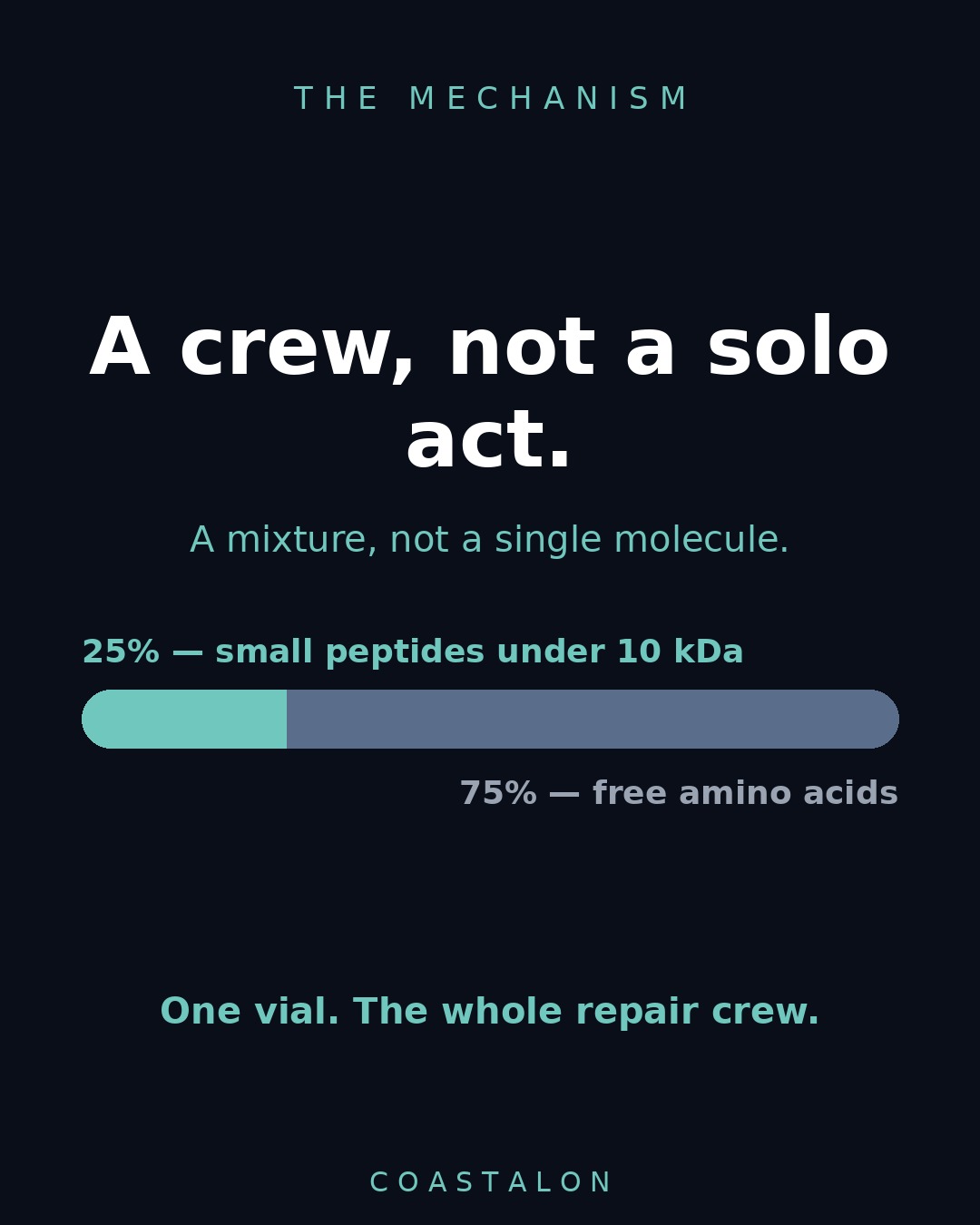
Cerebrolysin is a mixture, not a single molecule — so there is no single sequence or structure to show. It is made by enzymatic digestion of purified porcine brain protein, and the composition is approximately 25% short bioactive peptides (under 10 kDa) and 75% free amino acids.
It is also known as FPF-1070. It was developed in Austria and is manufactured by EVER Neuro Pharma. It is a prescription drug in 45+ countries — and it is not FDA-approved in the United States, where it is research use only.
Mimicking the brain's own growth factors
- The peptides mimic endogenous neurotrophic factors. In preclinical research, Cerebrolysin’s peptide fragments are studied for how they mimic BDNF, NGF, GDNF, and CNTF — the brain’s own growth-factor signals.
- The studied signaling runs through Trk receptors. The reported pathways are TrkA/TrkB and the PI3K/Akt and MAPK/ERK cascades downstream of them.
- The reported effects are anti-apoptotic, anti-inflammatory, and pro-neuroplastic. Those findings come from cell-culture and animal models — preclinical research, not human outcome claims. No single target or affinity figure is claimed here, because a mixture has no single target to measure.
That is the repair crew, in one sentence: a mixture of peptides studied for how they echo the brain’s own repair signals.
Dozens of trials. An honestly mixed verdict.
Cerebrolysin is one of the most studied compounds in the research literature: dozens of randomized trials and two Cochrane reviews. The honest verdict is mixed — and this page states it plainly rather than burying it.
The 2023 Cochrane review of Cerebrolysin for acute ischaemic stroke (7 trials, 1,773 participants) found probably little to no difference in death from any cause (RR 0.96), and more non-fatal serious adverse events (RR 2.39). The largest trial, CASTA (n=1,070), missed its primary endpoint. The CARS rehabilitation trial (2016) found arm function at day 90 favored Cerebrolysin (Mann-Whitney 0.71), and a 2021 European Academy of Neurology guideline issued a recommendation for early motor rehabilitation after ischemic stroke. The CAPTAIN I/II traumatic brain injury trials reported small-to-medium benefits on combined outcome scales — neither large enough to settle the question.
Early recovery scores favor it; long-term benefit is unproven. That is the mixed verdict — research literature only, not a human outcome claim for this product.
Molecular specifications
| Composition | ~25% short bioactive peptides (<10 kDa), ~75% free amino acids |
|---|---|
| Source | Enzymatic digestion of purified porcine brain protein |
| Also Known As | FPF-1070 |
| Manufacturer | EVER Neuro Pharma, Austria |
| Status | Prescription drug in 45+ countries; not FDA-approved in the United States — research use only |
| Storage | 2-8°C protected from light; avoid repeated freeze-thaw cycles |
Selected literature
The following peer-reviewed references informed this page. Citations are provided for scientific context only.
- Cochrane review of Cerebrolysin for acute ischaemic stroke, 2023 (7 trials, 1,773 participants). Probably little to no difference in death from any cause (RR 0.96); more non-fatal serious adverse events (RR 2.39).
- CASTA trial (n=1,070): the largest randomized trial of Cerebrolysin; missed its primary endpoint.
- CARS rehabilitation trial, 2016: arm function at day 90 favored Cerebrolysin (Mann-Whitney 0.71).
- European Academy of Neurology guideline, 2021: recommendation for early motor rehabilitation after ischemic stroke.
- CAPTAIN I/II trials (traumatic brain injury): small-to-medium benefits on combined outcome scales; neither large enough to settle the question.
- Identity and composition: standardized preparation of low-molecular-weight peptides and free amino acids from enzymatic digestion of purified porcine brain protein; ~25% short bioactive peptides (<10 kDa), remainder free amino acids. Also known as FPF-1070; developed in Austria; manufactured by EVER Neuro Pharma.
Research Disclaimer
This product is intended strictly for laboratory research purposes only. It is not a drug, food, cosmetic, or dietary supplement and is not intended to diagnose, treat, cure, or prevent any disease. It is not for human or animal consumption. All information presented is derived from published scientific literature and is provided for educational reference only. By purchasing, the buyer affirms they are a qualified researcher or institution and assume full responsibility for the safe and lawful handling of this material.