One receptor, one signal
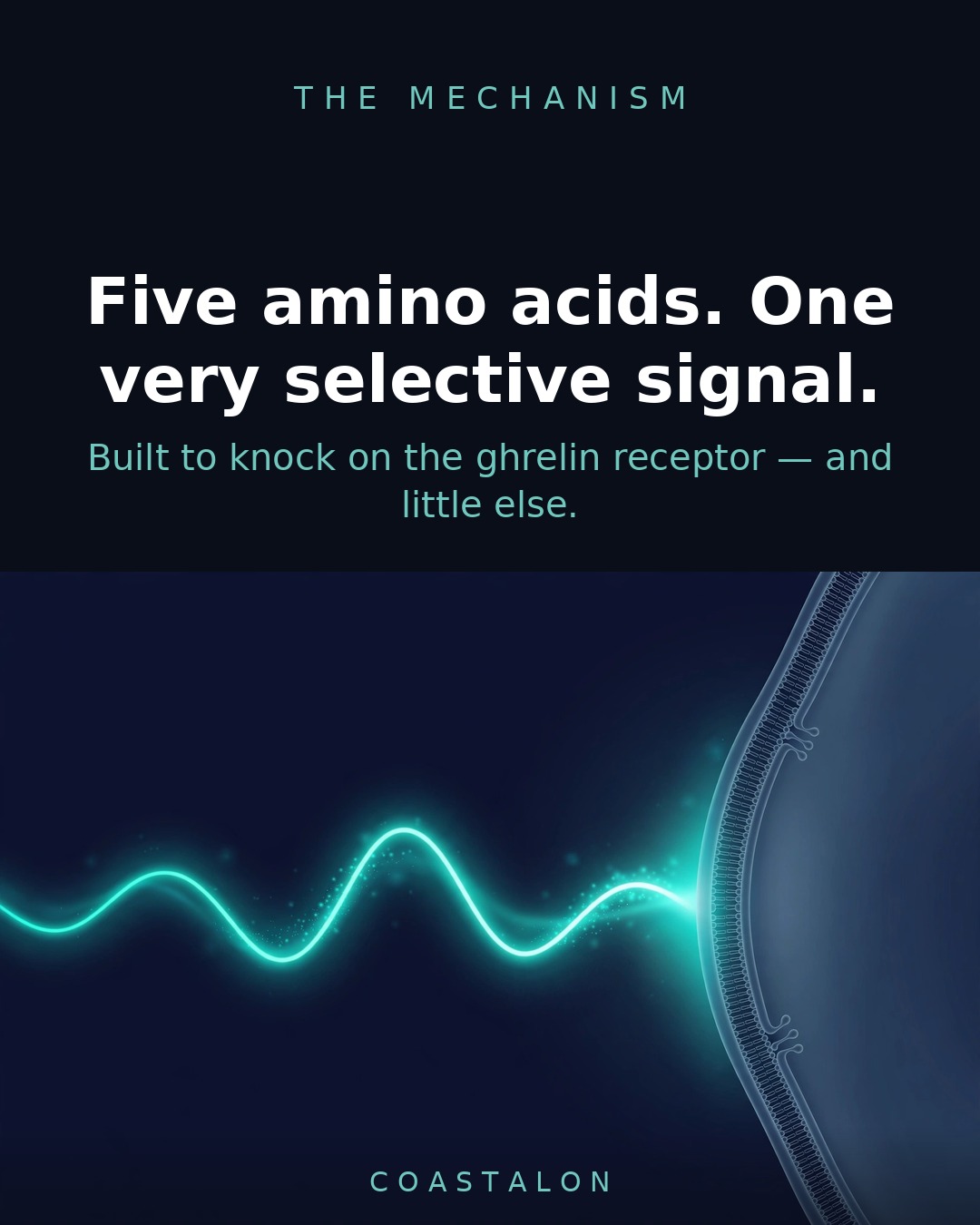
Ipamorelin is a five-residue peptide and a selective agonist at the ghrelin receptor (GHS-R1a) on pituitary somatotrophs — the cells that release growth hormone. It binds that receptor, and the pituitary answers with a pulse of GH.
What makes it notable is what it does not do. Older growth-hormone secretagogues such as GHRP-6 also raised ACTH and cortisol. Ipamorelin was designed to be selective for the ghrelin receptor — a cleaner signal.
Five residues, two non-standard
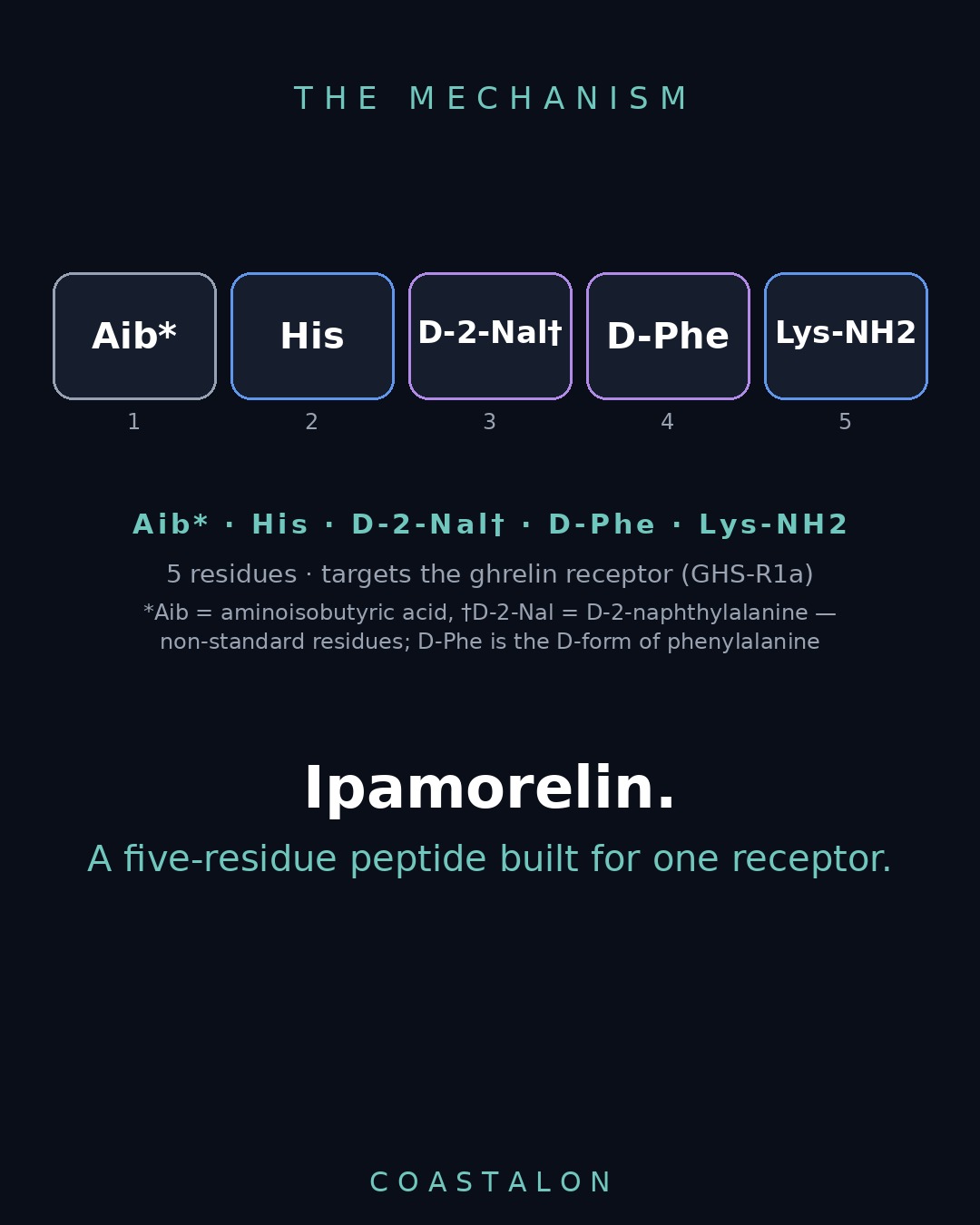
Ipamorelin’s sequence is five residues long. Two of them are non-standard — flagged here, never silently shown as standard amino acids:
Bind the receptor, release the pulse
- Ipamorelin binds the ghrelin receptor (GHS-R1a). The peptide docks onto the receptor on the surface of pituitary somatotrophs.
- The PLC/IP3/calcium pathway activates. Inside the cell, the signal runs through phospholipase C and intracellular calcium — a different pathway from the cAMP route used by GHRH analogs.
- The pituitary releases a pulse of GH. The response is pulsatile: a rise, then a return to baseline — the pattern the body’s own signaling uses.
As potent as GHRP-6 — without the cortisol rise
In studies, ipamorelin released growth hormone as potently as GHRP-6 — without the cortisol rise older secretagogues brought with them (Raun et al., European Journal of Endocrinology, 1998). Doses far above the effective range — up to 200× the GH ED50 — did not raise ACTH or cortisol above control levels in the reported models, with minimal change in prolactin.
These are study findings, reported here as research — not human efficacy claims.
Molecular specifications
| Amino Acid Sequence | Aib-His-D-2-Nal-D-Phe-Lys-NH₂ |
|---|---|
| Molecular Weight | 711.9 g/mol |
| Molecular Formula | C₃₈H₄₉N₉O₅ |
| CAS Number | 170851-70-4 |
| Storage | −20°C long-term, 4°C short-term up to 4 weeks |
Selected literature
The following peer-reviewed references informed this page. Citations are provided for scientific context only.
- Raun K, Hansen BS, Johansen NL, et al. “Ipamorelin, the first selective growth hormone secretagogue.” Eur J Endocrinol. 1998; 139(5): 552–561. doi:10.1530/EJE.0.1390552.
Research Disclaimer
This product is intended strictly for laboratory research purposes only. It is not a drug, food, cosmetic, or dietary supplement and is not intended to diagnose, treat, cure, or prevent any disease. It is not for human or animal consumption. All information presented is derived from published scientific literature and is provided for educational reference only. By purchasing, the buyer affirms they are a qualified researcher or institution and assume full responsibility for the safe and lawful handling of this material.