A copy of your own GHRH signal
CJC-1295 No DAC — also called Modified GRF (1-29) — is a 29-residue analogue of GHRH, the hormone your brain uses to signal the pituitary. Native GHRH clears in minutes. Four substitutions stretch that to about 30 minutes, the widely reported estimate for this form.
The “No DAC” matters. The DAC version carries an albumin-binding tail that makes the signal last for days. Without it, the signal stays a pulse, not a flood — closer to the way your own GHRH behaves.
Twenty-nine residues, four swaps
The 29-residue strip below is the molecule visual — the verified sequence, with the modified residue flagged:
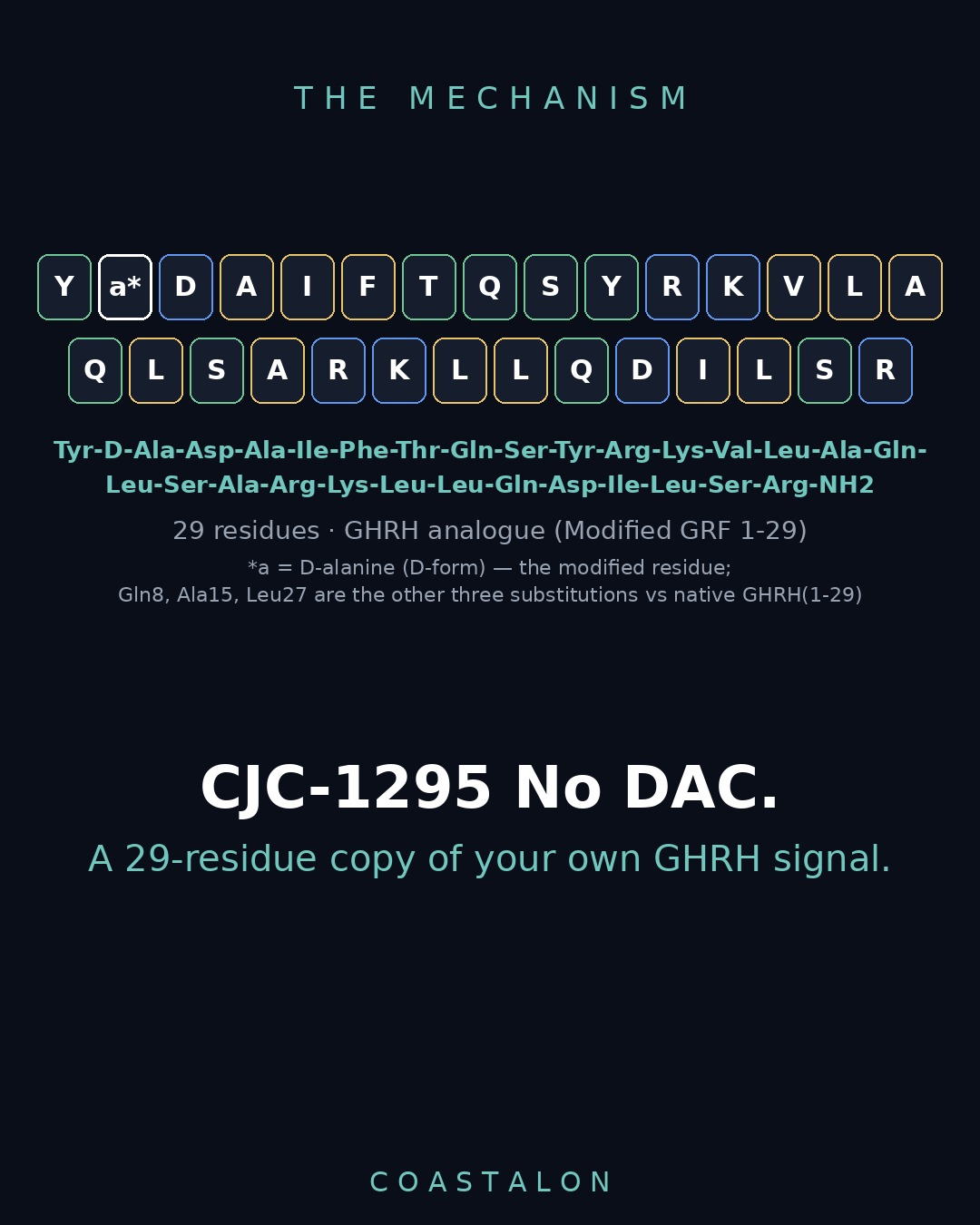
The four substitutions versus native GHRH(1-29) each do one job: D-Ala2 blocks DPP-4, the enzyme that shreds native GHRH; Gln8 resists deamidation; Ala15 boosts receptor affinity; Leu27 blocks methionine oxidation.
The other side of the pulse
- CJC-1295 binds the GHRH receptor (GHRHR). The peptide docks onto the receptor on pituitary somatotrophs.
- The Gs/cAMP/PKA pathway activates. Inside the cell, the signal runs through adenylyl cyclase and cAMP — complementary to ipamorelin’s calcium pathway, which is why the two are paired in the trio.
- The pituitary answers with a pulse of GH. Without the DAC tail, the signal clears in about 30 minutes — a pulse, not a flood.
Design first, preclinical evidence
There is an important honesty note for this compound: no standalone human study of Mod GRF 1-29 exists, and no human data from the DAC-conjugated variant was borrowed to fill the gap. The design slide in the episode — four swaps, one job — is a design diagram, not a trial claim.
What the preclinical evidence does show: in-vitro cAMP assays report full agonism at the GHRH receptor, and the Mod GRF evidence base is preclinical — rat pituitary GH-release assays and structure–activity work on DPP-4 resistance — rather than randomized human trials. The “about 30 minutes” figure is the widely reported estimate for the No DAC form, not a measured human pharmacokinetic value.
Molecular specifications
| Amino Acid Sequence | Tyr-D-Ala-Asp-Ala-Ile-Phe-Thr-Gln-Ser-Tyr-Arg-Lys-Val-Leu-Ala-Gln-Leu-Ser-Ala-Arg-Lys-Leu-Leu-Gln-Asp-Ile-Leu-Ser-Arg-NH₂ |
|---|---|
| Molecular Weight | ~3,367 g/mol |
| Molecular Formula | C₁₅₂H₂₅₂N₄₄O₄₂ |
| CAS Number | 863288-34-0 |
| Storage | −20°C long-term, 4°C short-term up to 4 weeks |
Selected literature
The following peer-reviewed references informed this page. Citations are provided for scientific context only.
- Composition: CJC-1295 No DAC = Modified GRF (1-29), sequence Tyr-D-Ala-Asp-Ala-Ile-Phe-Thr-Gln-Ser-Tyr-Arg-Lys-Val-Leu-Ala-Gln-Leu-Ser-Ala-Arg-Lys-Leu-Leu-Gln-Asp-Ile-Leu-Ser-Arg-NH2, formula C152H252N44O42, MW ~3,367 Da, CAS 863288-34-0, PubChem CID 56841945. Four substitutions vs native GHRH(1-29): D-Ala2, Gln8, Ala15, Leu27.
- Evidence note: no standalone human study of Mod GRF 1-29 has been published. The evidence base is preclinical (in-vitro cAMP assays reporting full agonism at the GHRH receptor; rat pituitary GH-release assays). Human data for the DAC-conjugated variant (e.g., Teichman et al., 2006) describes a different molecule and is not used here.
Research Disclaimer
This product is intended strictly for laboratory research purposes only. It is not a drug, food, cosmetic, or dietary supplement and is not intended to diagnose, treat, cure, or prevent any disease. It is not for human or animal consumption. All information presented is derived from published scientific literature and is provided for educational reference only. By purchasing, the buyer affirms they are a qualified researcher or institution and assume full responsibility for the safe and lawful handling of this material.