A stabilizer, not a stimulant
SS-31 is a four-residue peptide — one of the smallest peptides in the series. It is designed to concentrate in the cardiolipin-rich inner mitochondrial membrane, at concentrations reported at 1,000–10,000× the level in the surrounding cytoplasm.
That targeting is the whole point: SS-31 does not stimulate energy production. It stabilizes the membrane that holds the energy chain together.

Four residues, one target
SS-31’s sequence is short enough to read at a glance. The second residue is a modified tyrosine — flagged here, never silently shown as standard:
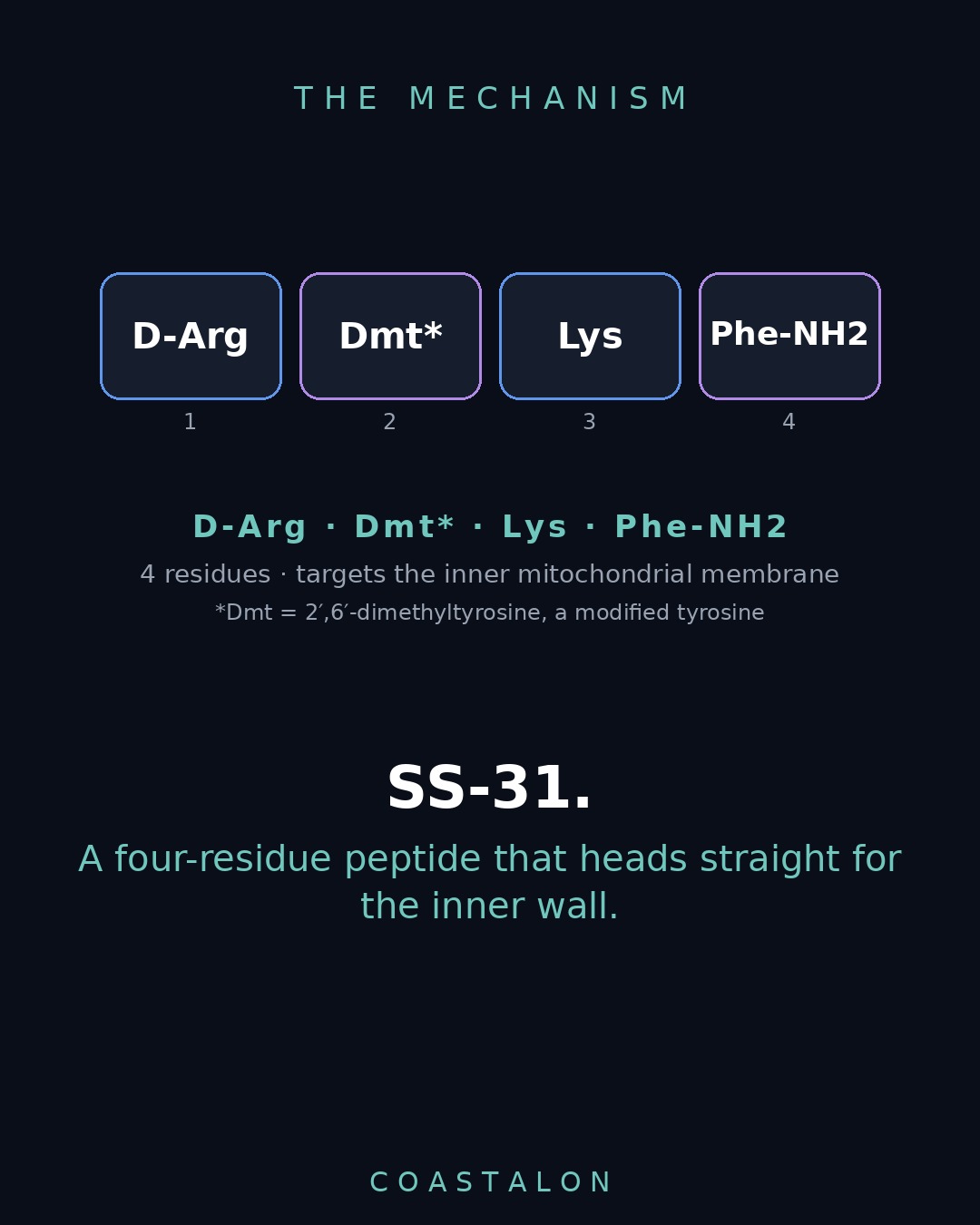
The two basic residues (D-Arg and Lys) align with the phosphate head groups of cardiolipin, while the aromatic residues (Dmt and Phe) insert into the lipid’s acyl chain region — an electrostatic-plus-hydrophobic fit that anchors the peptide to the membrane.
Locking onto cardiolipin
- SS-31 concentrates in the inner membrane. Drawn to cardiolipin, the signature lipid of the inner mitochondrial membrane, it accumulates where the energy chain lives.
- It locks onto cardiolipin. The peptide binds the lipid that holds the electron transport chain together, stabilizing the cristae folds.
- The stabilized complex resists oxidative damage. The SS-31/cardiolipin complex inhibits the cytochrome c peroxidase activity that catalyzes cardiolipin peroxidation — keeping the energy chain running clean.
What studies found
In studies, SS-31 protected cardiolipin from oxidative damage (Birk et al., Journal of the American Society of Nephrology, 2013). The paper reported that the SS-31/cardiolipin complex inhibits cytochrome c peroxidase activity, and that pretreatment protected cristae membranes during renal ischemia and prevented mitochondrial swelling.
These are study findings, reported here as research — not human efficacy claims.
Molecular specifications
| Amino Acid Sequence | D-Arg-Dmt-Lys-Phe-NH₂ |
|---|---|
| Molecular Weight | 639.8 g/mol |
| Molecular Formula | C₃₂H₄₉N₉O₅ |
| CAS Number | 736992-21-5 |
| Storage | −20°C long-term, 4°C short-term up to 4 weeks |
Selected literature
The following peer-reviewed references informed this page. Citations are provided for scientific context only.
- Birk AV, Liu S, Soong Y, Mills W, Singh P, Warren JD, Seshan SV, Pardee JD, Szeto HH. “The Mitochondrial-Targeted Compound SS-31 Re-Energizes Ischemic Mitochondria by Interacting with Cardiolipin.” J Am Soc Nephrol. 2013; 24(8): 1250–1261. doi:10.1681/ASN.2012121216.
- Szeto HH, Birk AV. “The Mitochondrial-Targeted Peptide SS-31.” Clin Pharmacol Ther. 2014. PMID 25188726.
Research Disclaimer
This product is intended strictly for laboratory research purposes only. It is not a drug, food, cosmetic, or dietary supplement and is not intended to diagnose, treat, cure, or prevent any disease. It is not for human or animal consumption. All information presented is derived from published scientific literature and is provided for educational reference only. By purchasing, the buyer affirms they are a qualified researcher or institution and assume full responsibility for the safe and lawful handling of this material.