The cell’s master antioxidant
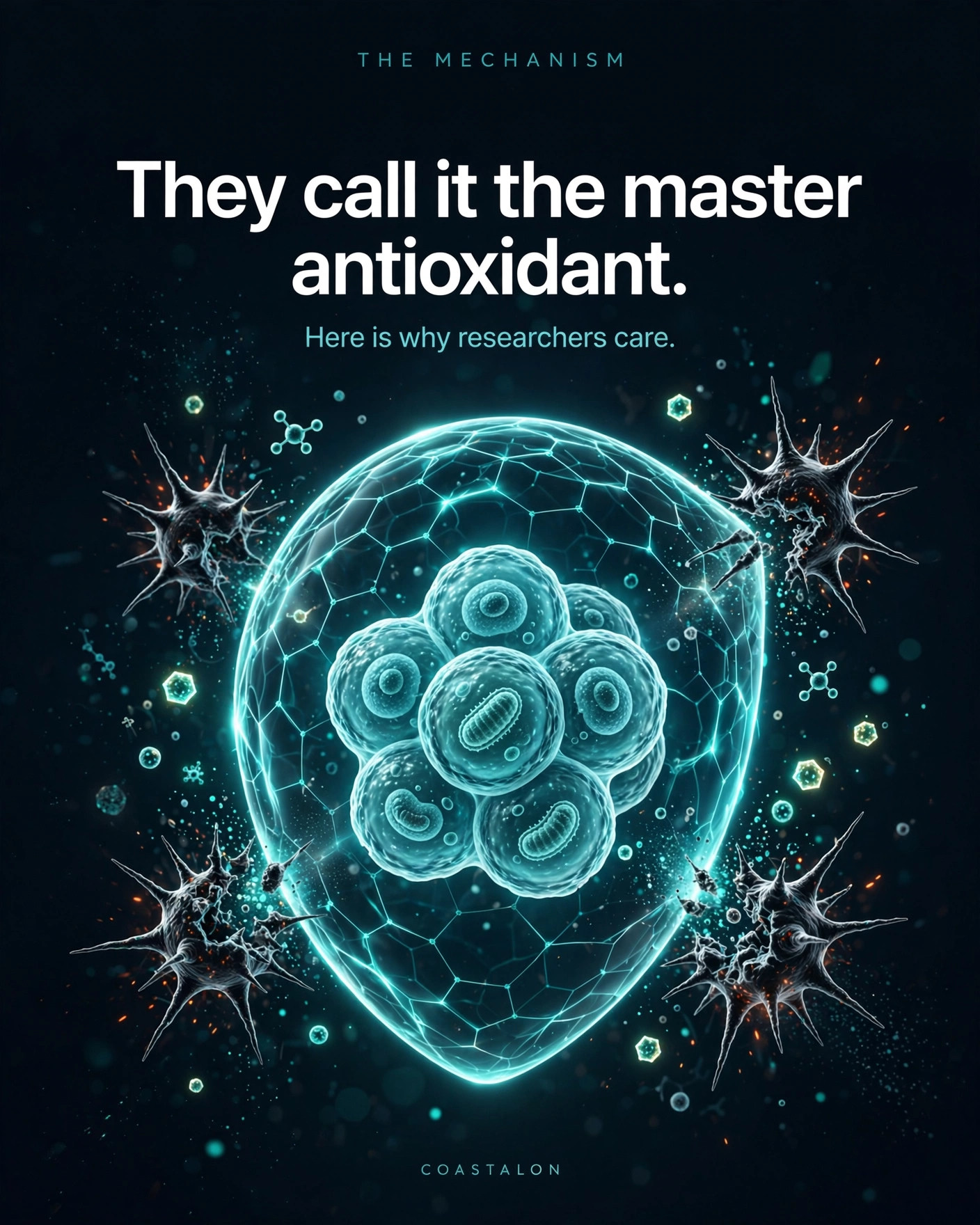
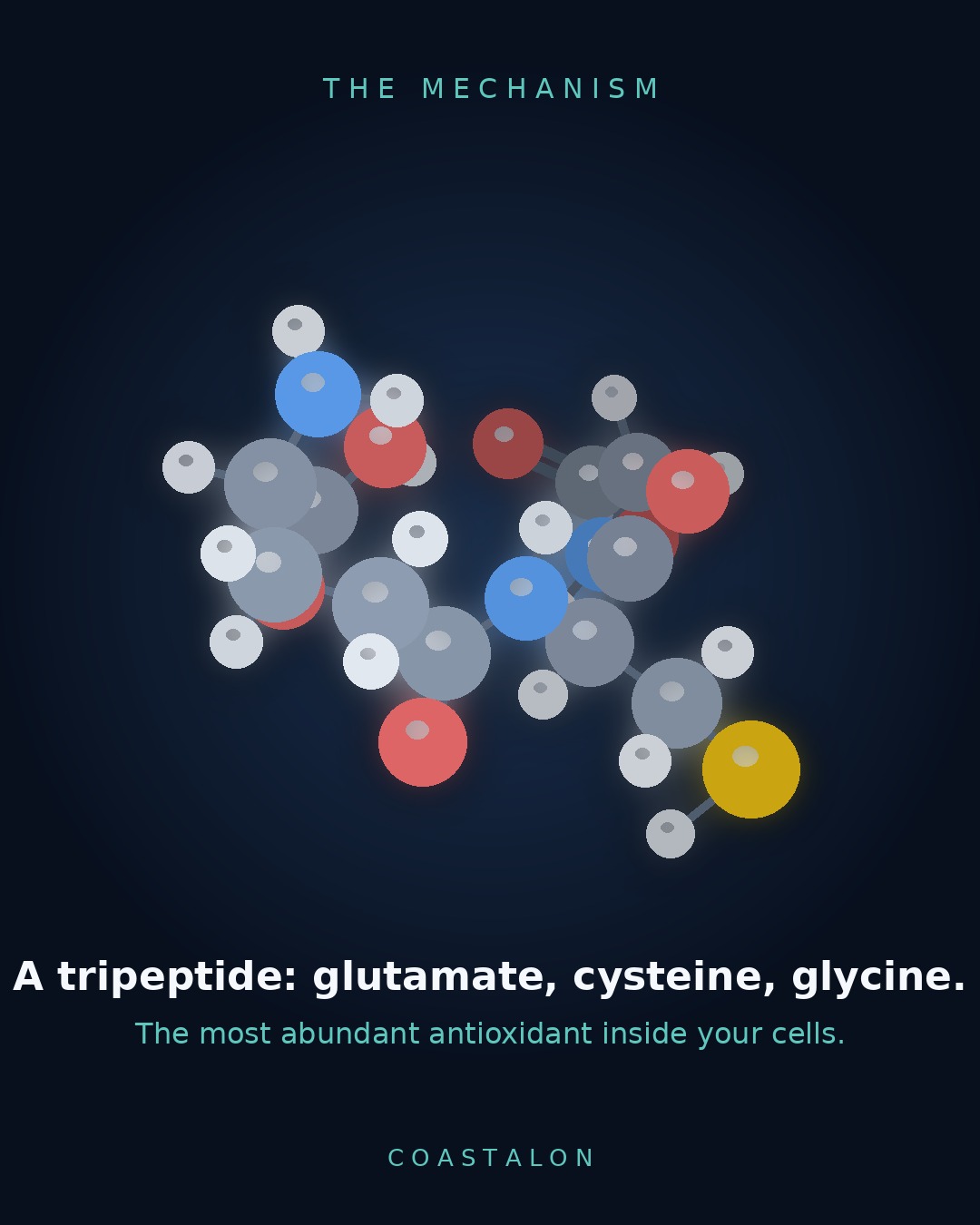
Glutathione is a tripeptide: glutamate, cysteine, and glycine. It is the most abundant antioxidant inside your cells, and one of the most studied molecules in oxidative stress research.
Antioxidants neutralize free radicals — unstable molecules that damage cells. Glutathione is unusual because it does not get used up in the process: it disarms a free radical, then recycles, ready to work again.
Three amino acids, one tripeptide
Glutathione is built from three amino acids, with an unusual bond between the first two:
gamma-Glu · Cys · Gly
The gamma bond between glutamate and cysteine is what makes glutathione different from an ordinary tripeptide — and it is also what lets the molecule survive inside the cell long enough to do its job. The cysteine residue carries the sulfur group that does the actual antioxidant work.
Disarm, then recycle
- Glutathione (GSH) disarms a free radical. The reduced form donates an electron, neutralizing the radical before it can damage the cell.
- Two GSH molecules pair up as GSSG. The oxidized form is two glutathione molecules linked together.
- The cell recycles GSSG back to GSH. An enzyme, glutathione reductase, splits the pair and restores the working form — so the cycle repeats.
That cycle — GSH to GSSG, and back again — is why glutathione is described as a recycling antioxidant rather than a one-shot one.
At the center of redox balance
Researchers study glutathione because it sits at the center of redox balance — the equilibrium that decides how much oxidative stress a cell carries. It is one of the most studied molecules in aging research, and a standard reference point whenever oxidative stress is measured in the lab.
That interest is research interest: the findings discussed here come from laboratory and animal studies, not from human outcome trials.
Molecular specifications
| Amino Acid Sequence | gamma-Glu-Cys-Gly |
|---|---|
| Molecular Weight | 307.3 g/mol |
| Molecular Formula | C₁₀H₁₇N₃O₆S |
| CAS Number | 70-18-8 |
| Storage | -20°C long-term, protected from light and moisture |
Selected literature
The following peer-reviewed references informed this page. Citations are provided for scientific context only.
- Meister A & Anderson ME. (1983). Glutathione. Annual Review of Biochemistry, 52, 711-760.
- Forman HJ, et al. (2009). Glutathione: overview of its protective roles, measurement, and biosynthesis. Molecular Aspects of Medicine, 30(1-2), 1-12.
- Lu SC. (2013). Glutathione synthesis. Biochimica et Biophysica Acta, 1830(5), 3143-3153.
- Dringen R. (2000). Metabolism and functions of glutathione in brain. Progress in Neurobiology, 62(6), 649-671.
- Deponte M. (2013). Glutathione catalysis and the reaction mechanisms of glutathione-dependent enzymes. Biochimica et Biophysica Acta, 1830(5), 3217-3266.
Research Disclaimer
This product is intended strictly for laboratory research purposes only. It is not a drug, food, cosmetic, or dietary supplement and is not intended to diagnose, treat, cure, or prevent any disease. It is not for human or animal consumption. All information presented is derived from published scientific literature and is provided for educational reference only. By purchasing, the buyer affirms they are a qualified researcher or institution and assume full responsibility for the safe and lawful handling of this material.