One molecule, three receptors
Retatrutide is the first weight-loss compound The Mechanism has covered — and the first triple agonist. Semaglutide activates one receptor, tirzepatide two. Retatrutide activates three: GLP-1, GIP, and glucagon, all from a single 39-amino-acid peptide built on the GIP sequence.
The number that put it on the map came from a Phase 2 trial: the top dose averaged 24.2% body-weight loss over 48 weeks. Phase 3 has since confirmed it — 25.0% at 80 weeks in the TRIUMPH-1 trial. That is the strongest trial data the series has run, and it is human data, not animal work. The honest part: retatrutide is still investigational. It is not FDA-approved anywhere.

Thirty-nine amino acids, three receptors
Retatrutide (LY3437943, Eli Lilly) is a synthetic 39-amino-acid peptide, built on the GIP sequence and modified to hit all three receptors at once. It is a unimolecular triple agonist — one molecule, three jobs.
YA1QGTFTSDYSIL2LDKK4AQA1AFIEYLLEGGPSSGAPPPS3
The sequence above is the molecule visual — the verified 39-residue sequence, in order, with its modifications marked: A1 = 2-aminoisobutyric acid (Aib, positions 2 and 20); L2 = α-methyl-leucine (position 13); S3 = L-serinamide (the C-terminus, position 39); K4 = the lysine at position 17 carrying the (AEEA)-(γ-Glu)-(C20 diacid) side chain. The N-terminus is a free tyrosine; the C-terminus is serinamide.
There is no plain PubChem CID for retatrutide — name and CAS lookups return nothing. The canonical registry reference is ChEMBL5095485.
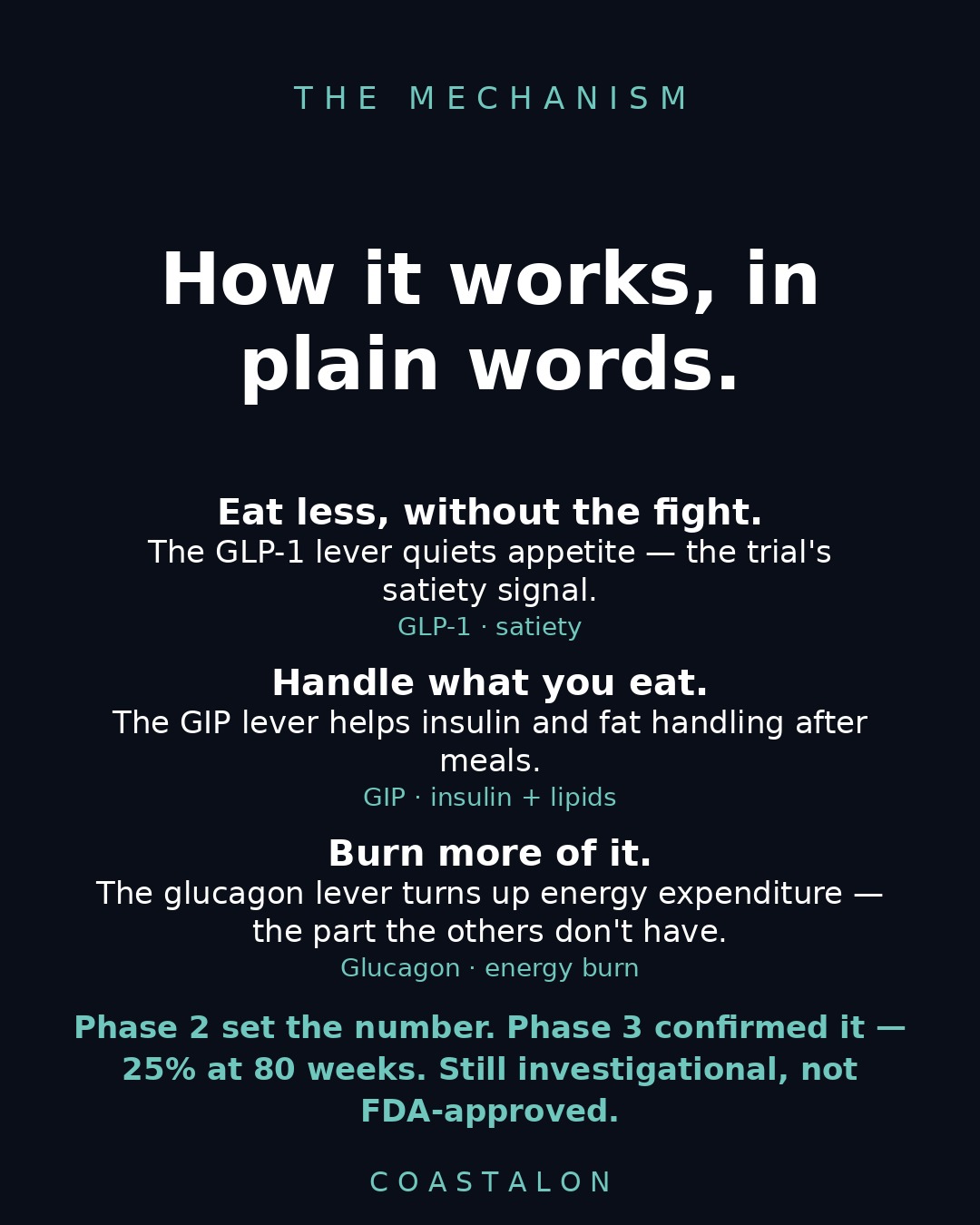
How it works, in plain words
- Less appetite. The GLP-1 lever is the satiety signal — food quiets down, so less comes in. This is the lever semaglutide pulls on its own.
- Better handling. The GIP lever helps the body handle insulin and fat after eating. This is the second lever tirzepatide adds.
- More burn. The glucagon lever turns up energy expenditure, so more gets used. This is the lever only retatrutide has — the burn the others don’t pull.
That is retatrutide, in one sentence: less appetite, better handling, more burn — three receptors, one molecule, in the trial literature.
Phase 2 set the number. Phase 3 confirmed it.
The honest part of this episode is how strong the evidence is — and where it stops. Retatrutide has something no other compound in this series has: large human randomized trials, published in the two biggest medical journals.
Phase 2 (Jastreboff et al., New England Journal of Medicine, 2023): 338 adults with obesity, 48 weeks, weekly doses of 1, 4, 8, or 12 mg. Mean weight loss ran 8.7%, 17.1%, 22.8%, and 24.2% across the doses, against 2.1% on placebo. At the top dose, 93% of participants lost at least 10% of body weight and 83% lost at least 15%. The weight curves had not plateaued at week 48 — the full effect wasn’t yet captured.
Phase 3 confirmed it. TRIUMPH-1 (Jastreboff et al., New England Journal of Medicine, September 29, 2026): 2,339 adults with obesity without diabetes, 80 weeks. Mean weight reductions of 17.6%, 23.7%, and 25.0% on 4, 9, and 12 mg, against 3.9% on placebo. TRIUMPH-2 (adults with obesity and type 2 diabetes) was published in The Lancet the same week.
And the stop: retatrutide is still investigational. It is not FDA-approved anywhere, there is no legal pharmacy supply outside Lilly’s trials, and Eli Lilly has said it plans to apply for US approval in the first quarter of 2027. Strong trial data, no approval yet — that is the honest verdict.
Molecular specifications
| Amino Acid Sequence | YA1QGTFTSDYSIL2LDKK4AQA1AFIEYLLEGGPSSGAPPPS3 (39 residues) |
|---|---|
| Molecular Weight | 4,731.0 g/mol |
| Molecular Formula | C₂₂₁H₃₄₂N₄₆O₆₈ |
| CAS Number | 2381089-83-2 |
| Also Known As | LY3437943 |
| Registry | ChEMBL5095485 (no plain PubChem CID exists) |
| Status | Not FDA-approved — research use only |
| Storage | −20°C long-term, 4°C short-term up to 4 weeks |
Selected literature
The following peer-reviewed references informed this page. Citations are provided for scientific context only.
- Coskun T, et al. “LY3437943, a novel triple glucagon, GIP, and GLP-1 receptor agonist for glycemic control and weight loss: From discovery to clinical proof of concept.” Cell Metab. 2022; 34(9): 1234–1247.e9. (PMID 35985340) — Discovery and mechanism of the triple agonist.
- Jastreboff AM, et al. “Triple-Hormone-Receptor Agonist Retatrutide for Obesity — A Phase 2 Trial.” N Engl J Med. 2023; 389(6): 514–526. (PMID 37366315) — n=338, 48 weeks; 24.2% mean weight loss at 12 mg, 2.1% placebo; 93% ≥10%, 83% ≥15% at 12 mg; curves not plateaued.
- Jastreboff AM, et al. “Retatrutide, a Triple Hormone Receptor Agonist, for Treatment of Obesity.” N Engl J Med. 2026. (PMID 42814954) — TRIUMPH-1: n=2,339, 80 weeks; 17.6% / 23.7% / 25.0% (4/9/12 mg) vs 3.9% placebo.
- Bellido V, et al. “Retatrutide in adults with obesity and type 2 diabetes (TRIUMPH-2).” Lancet. 2026; 408(10563): 1455–1472. (PMID 42810372) — TRIUMPH-2, published the same week as TRIUMPH-1.
- Identity: retatrutide, synthetic 39-amino-acid peptide, GIP-sequence scaffold, formula C221H342N46O68, MW 4,731.0 Da, CAS 2381089-83-2, UNII NOP2Y096GV, ChEMBL5095485. Sequence YA1QGTFTSDYSIL2LDKK4AQA1AFIEYLLEGGPSSGAPPPS3, with Aib at positions 2 and 20, α-methyl-leucine at position 13, L-serinamide at the C-terminus, and the (AEEA)-(γ-Glu)-(C20 diacid) side chain on Lys17.
- Evidence note: Phase 2 NEJM 2023 (n=338, 48 weeks) and Phase 3 TRIUMPH-1 NEJM 2026 (n=2,339, 80 weeks) plus TRIUMPH-2 Lancet 2026 — large human randomized trials. Still investigational, not FDA-approved anywhere; no legal pharmacy supply outside Lilly trials.
Research Disclaimer
This product is intended strictly for laboratory research purposes only. It is not a drug, food, cosmetic, or dietary supplement and is not intended to diagnose, treat, cure, or prevent any disease. It is not for human or animal consumption. All information presented is derived from published scientific literature and is provided for educational reference only. By purchasing, the buyer affirms they are a qualified researcher or institution and assume full responsibility for the safe and lawful handling of this material.