The recovery peptide everyone asks about
TB-500 is the synthetic active fragment of thymosin beta-4 — a protein found in almost every cell of the body. It is not the whole protein. It is the seven-amino-acid piece that does the actin-binding work: Ac-LKKTETQ, residues 17–23 of the parent protein.
That distinction is the whole story. The full protein, thymosin beta-4, is 43 amino acids long and is sold separately as its own product. TB-500 is the fragment researchers study for how repair cells reach damaged tissue — by freeing the actin that lets cells move.
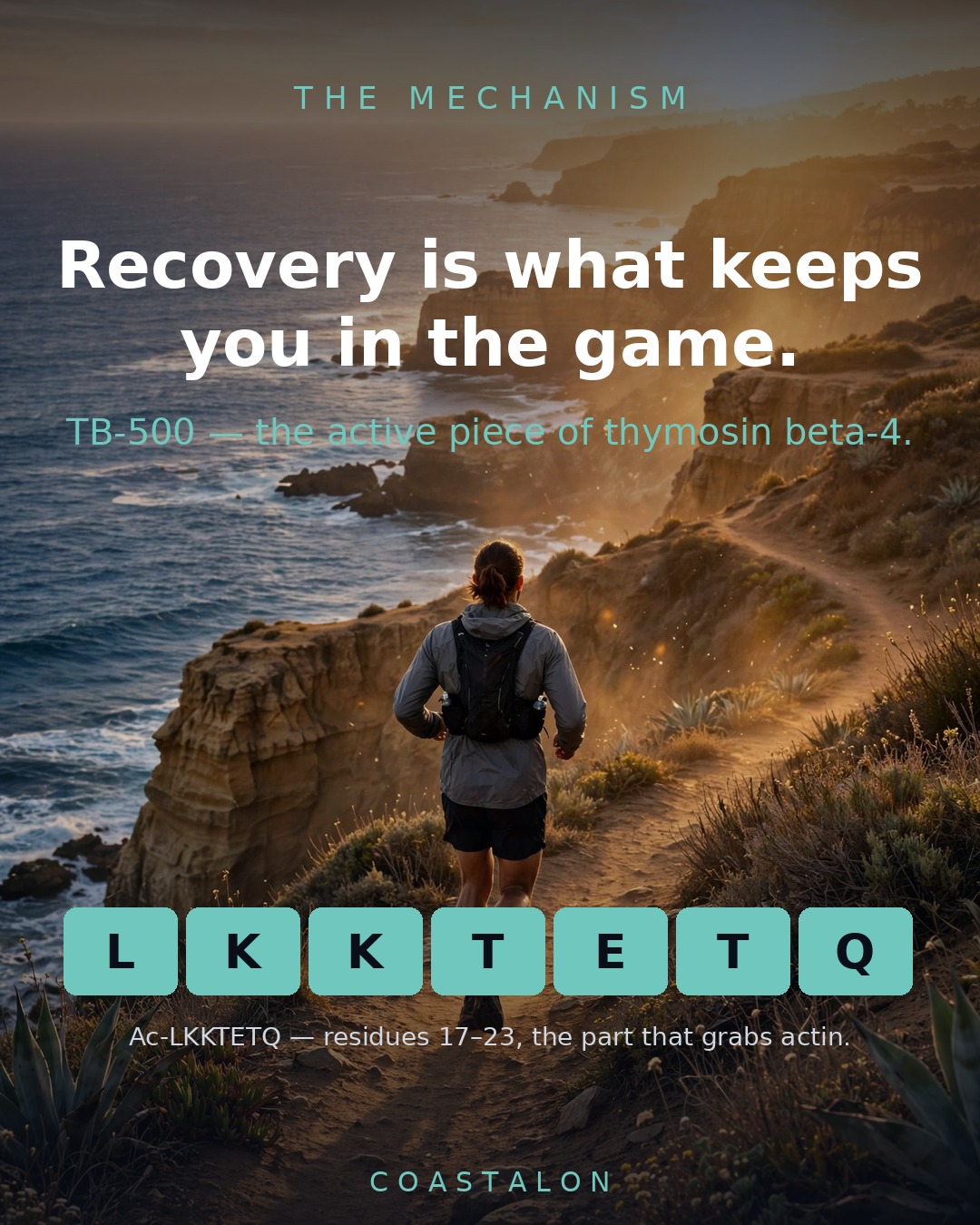
Seven amino acids, the active piece
TB-500 is the synthetic fragment Ac-LKKTETQ — seven amino acids, N-acetylated. It is the actin-binding core of thymosin beta-4, the motif the parent protein uses to hold the actin monomers that cells build their skeletons from.
Leu-Lys-Lys-Thr-Glu-Thr-Gln
The sequence above is the molecule visual — the verified core sequence, in order: LKKTETQ, residues 17–23 of thymosin beta-4 (UniProt P62328). The parent protein’s full 43-residue sequence is SDKPDMAEIEKFDKSKLKKTETQEKNPLPSKETIEQEKQAGES.
TB-500 and the full protein are different products: the fragment is studied for the actin mechanism; the 43-residue parent is thymosin beta-4 itself.
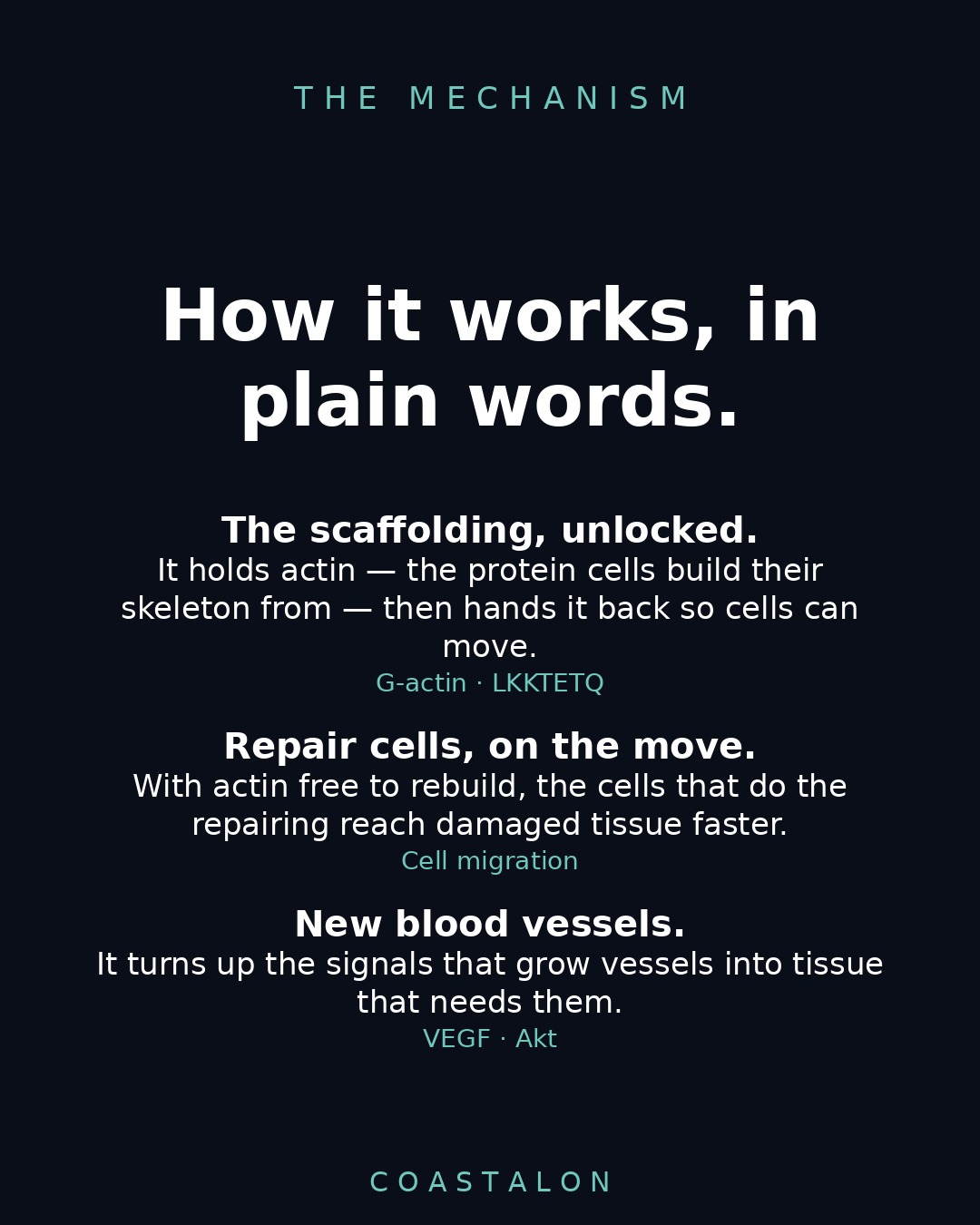
How it works, in plain words
- The scaffolding, unlocked. In preclinical research, TB-500 is studied for how it holds actin — the protein cells build their skeleton from — then hands it back so cells can move. The mechanism runs through G-actin sequestration, with the LKKTETQ motif doing the binding.
- Repair cells, on the move. With actin free to rebuild, the cells that do the repairing reach damaged tissue faster. The published work describes cell migration driven by this actin handoff, with ILK and FAK signaling involved (Bock-Marquette et al., 2004).
- New blood vessels. It is studied for how it turns up the signals that grow vessels into tissue that needs them — VEGF upregulation and angiogenesis in the thymosin beta-4 literature.
That is TB-500, in one sentence: the scaffolding unlocked, repair cells on the move, new blood vessels — in research, not in people.
Decades of animal studies. Almost no human data.
The honest part of this episode is the evidence gap, and this page states it plainly rather than burying it. TB-500 and its parent protein have decades of animal work behind them — wound healing, cardiac repair after infarction, corneal remodeling, and nervous-system injury models.
Only one small human trial exists: a multicenter study of the parent protein in chronic venous ulcers (Guarnera et al., 2010). Nothing exists for tendon or muscle recovery, and no large human trial of the fragment has finished.
The animal case is strong; the human case is barely started. That is the honest verdict — research literature only, not a human outcome claim for this product.
Molecular specifications
| Amino Acid Sequence | Ac-Leu-Lys-Lys-Thr-Glu-Thr-Gln (Ac-LKKTETQ) |
|---|---|
| Molecular Weight | 889.0 g/mol |
| Molecular Formula | C₃₈H₆₈N₁₀O₁₄ |
| CAS Number | 885340-08-9 |
| Also Known As | Thymosin beta-4 fragment, residues 17–23 |
| Parent Protein | Thymosin beta-4 — 43 amino acids, ~4,963.5 g/mol, CAS 77591-33-4 |
| Status | Not FDA-approved — research use only |
| Storage | −20°C long-term, 4°C short-term up to 4 weeks |
Selected literature
The following peer-reviewed references informed this page. Citations are provided for scientific context only.
- Goldstein AL, et al. “Thymosin beta 4: a novel regulator of actin and the cellular cytoskeleton.” Expert Opin Biol Ther. 2012; 12(1): 37–51. — G-actin sequestration review: thymosin beta-4 as the cell’s main G-actin buffer.
- Bock-Marquette I, et al. “Thymosin beta4 activates integrin-linked kinase and promotes cardiac cell migration, survival and cardiac repair.” Nature. 2004; 432: 466–472. (PMID 15565145) — ILK and FAK activation, cardiac cell migration and survival.
- Smart N, et al. “Thymosin beta4 induces adult epicardial progenitor mobilization and neovascularization.” Nature. 2007; 445: 177–182. — Epicardial progenitor activation after cardiac injury.
- Philp D, et al. “Thymosin beta 4 promotes wound repair.” Wound Repair Regen. 2004; 12: 463–470. — Dermal wound healing: keratinocyte and endothelial migration.
- Sosne G, et al. “Thymosin beta 4 promotes corneal wound healing.” FASEB J. 2010; 24: 4756–4765. — Corneal remodeling.
- Guarnera G, et al. “Thymosin beta 4 in chronic venous ulcers.” 2010. (PMID 20536470) — The one small multicenter human trial: chronic venous ulcers.
- Xiong Y, et al. “Thymosin beta 4 in CNS injury models.” Neurol Res. 2011; 33: 503–512. — Nervous-system injury models.
- Young JD, et al. “Thymosin beta 4 sulfoxide as a monocyte-derived anti-inflammatory.” Nat Med. 1999. (PMID 10581087) — Anti-inflammatory activity of the sulfoxide form.
- Ying L, et al. “Thymosin beta 4 and actin regulation.” Curr Protein Pept Sci. 2023. (PMID 36464872) — G-actin sequestration and cell-migration mechanism.
- Identity: TB-500, synthetic fragment Ac-LKKTETQ (residues 17–23 of thymosin beta-4), formula C38H68N10O14, MW 889.0 Da, CAS 885340-08-9, PubChem CID 62707662. Parent protein thymosin beta-4: 43 amino acids, formula C212H350N56O78S, MW ~4,963.5 Da, CAS 77591-33-4, UniProt P62328.
- Evidence note: decades of animal studies across wound healing, cardiac repair, corneal remodeling, and CNS injury models. One small human trial (Guarnera et al., 2010, chronic venous ulcers). No human trial for tendon or muscle recovery; no large human randomized trial of the fragment has finished.
Research Disclaimer
This product is intended strictly for laboratory research purposes only. It is not a drug, food, cosmetic, or dietary supplement and is not intended to diagnose, treat, cure, or prevent any disease. It is not for human or animal consumption. All information presented is derived from published scientific literature and is provided for educational reference only. By purchasing, the buyer affirms they are a qualified researcher or institution and assume full responsibility for the safe and lawful handling of this material.